



If you have ever wondered what happens inside a budgie nest box after the eggs are laid, this guide walks you through it day by day.
This article is a written companion to my 10-minute timelapse that follows budgie chicks from egg to a fully feathered, flying young bird over 44 days. You can watch the full development here.
First 44 Days of Babies Timelapse
Below you will find the exact timeline, what the chicks look like at each stage, what the parents do, how to handle temperature, cleaning and food, and when a baby is ready to leave the nest.
If you breed budgies or just bought a young bird and want to understand how old it is, start here.
Quick summary for busy readers: Budgie eggs hatch after 18-21 days of incubation. Chicks hatch blind, deaf and naked. Eyes open around day 6-8. Pin feathers show around day 10-14. By day 22-25 most chicks are well feathered. They leave the nest box around day 30-33 and learn to eat on their own between day 35-44. Full independence usually comes at 6-8 weeks.
Before Day 1: Laying and Incubation
A budgie hen does not lay the whole clutch at once.
Typical pattern:
- 4 to 8 eggs per clutch, 5-6 is most common
- One egg every second day
- Incubation starts after the 2nd or 3rd egg
- Incubation lasts 18-21 days from the start of steady sitting
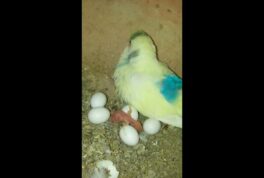
That is why chicks in the same box are different sizes. The first chick can be 6-8 days older than the last. In the video you can see this clearly – one chick is already covered in down while a younger sibling is still pink and tiny.
The hen does almost all of the sitting. The male feeds her at the entrance hole and guards the box. Do not open the box every hour during this time. One quick check per day is enough. Keep the room quiet, 20-24°C, with 12-14 hours of light.
A good nest box for budgies is a wooden budgie box, roughly 23 x 17 x 17 cm (9 x 6.5 x 6.5 in) with a 4.5 cm entrance hole and a concave circle in the floor so eggs do not roll. Put 2-3 cm of untreated wood shavings, hemp bedding or crushed corn cob on the bottom. No cedar or strongly scented shavings.
Egg Candling: How To Know If An Egg Is Fertile
Around day 5-7 after incubation starts you can candle the eggs.
In the video at around 01:10 you can see this moment – a small flashlight behind the egg in a dark room shows blood vessels and, in a live egg, a beating heart.
How to do it safely:
- Wait until the hen leaves the box to eat or drink
- Work in a dark room with clean, warm, dry hands
- Hold the egg gently against a small LED torch, never shake it
- Fertile: pinkish with spider-like veins, later a dark mass with air cell at the blunt end
- Clear/infertile: uniformly yellow with no veins after 7-8 days
Put the egg back within a minute or two. Do not candle every day. One check at day 7 and, if unsure, one more at day 10 is enough.
Infertile eggs can be left a few more days in case you misjudged, then removed. Do not throw away eggs that look fertile but are just late unless they are cracked, weeping or smell bad.
Day 1: Hatching
A newly hatched budgie looks nothing like a bird.
Weight is only 2-2.5 grams. Skin is pink, thin and almost transparent. No down, or just a few sparse yellowish filaments on the back. Eyes are sealed shut. Ears are closed. Head is disproportionately large and they cannot lift it for more than a second. Legs sprawl to the sides.
Hatching itself takes several hours. The chick uses an egg tooth to pip a small hole, rests, then turns inside the shell and cuts a line around it before pushing out. Do not help unless you are experienced – a chick that cannot get out on its own often has a yolk-sac problem, and pulling shell too early causes bleeding.
Right after hatching the hen keeps the chick under her constantly. The chick does not need seed or water. It lives from the yolk absorbed before hatching and then from what the parents regurgitate.
First feedings are frequent and tiny. The male feeds the hen, the hen feeds the chicks with warm, half-digested crop contents. You will hear faint ticking and smacking sounds from the box. That is normal.
What to do on day 1:
- Do nothing except confirm the chick is alive and under the hen
- Do not hand-feed a day-old chick if parents feed it
- Make sure the hen has fresh water, seed mix, egg food and cuttlebone within reach
- Keep the room draft-free
Days 2-5: The Pink Stage
This is the most fragile period.
The chick grows fast but still cannot regulate body temperature. It depends entirely on the hen for warmth. If you lift the lid you will see them huddled, pink, with a visible crop full of yellowish food on the right side of the neck.
Milestones:
- Day 2-3: neck gets a little stronger, head wobbles less
- Day 3-4: fine down starts to appear on the back and head
- Day 4-5: weight roughly doubles to triples, vocalization gets louder when hungry
- Umbilical area dries and closes
The crop should look full and rounded after feeds, then empty down before the next feed. A crop that stays hard and full for many hours, or a crop that is always empty and flat, are both warning signs.
Do not clean the box aggressively in this phase. Remove only obviously soiled, wet bedding with a spoon if needed and add a little dry bedding. Full bedding changes can chill chicks this young.
Handling: keep it to zero unless a chick is in trouble. Cold hands, perfume, long photo sessions – all of that is risk with no benefit at this age.
Days 6-8: Eyes Start To Open
Around day 6 the eyelids start to part. By day 8 most budgie chicks have narrow slits open. They still do not see well. Light startles them.
You will also notice:
- Down gets thicker, especially on back and wings
- Legs get stronger, chick can push itself up a little
- Beak darkens in many color varieties
- Weight around 10-15 grams depending on clutch position
This is the stage where many owners ask: 57 how to tell if a budgie is a baby
Three reliable signs a budgie is still a baby:
- Eyes: fully black eyes with no white iris ring = young bird under 4-5 months in most varieties
- Head bars: stripes on the forehead reaching down to the cere = under 3-4 months, before the first molt
- Cere and behavior: soft pinkish-purple cere in young males, pale blue-white in young females, plus clumsy climbing and constant begging
A 7-day-old obviously looks like a baby. But those same markers help you age a 6-week or 3-month fledgling in a pet shop.
Days 9-14: Pin Feathers Appear
This is when the chick starts to look like a real bird.
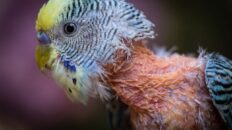
Dark blue-grey shafts push through the skin on wings and tail first, then back and head. They look like tiny plastic tubes. Inside each shaft is a developing feather filled with blood. That is why they are called blood feathers – do not pull or break them.
Timeline in this window:
- Day 9-10: wing pins visible under skin, then breaking through
- Day 11-12: tail pins, back pins
- Day 13-14: head pins, down still visible between pins, weight 20-30 grams
The hen spends less time sitting directly on them now because a pile of chicks keeps itself warm. She still broods at night.
Care tasks for week 2:
- Start daily quick checks: all crops full, no pasted vent, no splayed legs, no mites
- If bedding is damp, change part of it when the hen is out eating. Warm the new bedding to room temperature first
- Offer egg food daily: hard-boiled egg mashed with shell, plus a little cooked millet or commercial egg food. This is protein the parents turn into chick growth
- Keep calcium available: cuttlebone + mineral block. The hen is depleted after laying
Splayed legs show now if the floor is too slippery. If legs slide sideways instead of tucking under, fix the flooring immediately with more textured shavings and a concave base. Early correction works. Late correction often does not.
Days 15-21: Feathers Open
Between day 15 and 21 the change is dramatic. Pins open from the tip down and color appears.
In the timelapse this is the stretch where grey tubes turn green, blue, yellow or white almost overnight. Wing feathers unsheathe first, then tail, then body.
What to expect:
- Chicks preen constantly and scratch at sheaths – normal
- They get itchy and grumpy when many feathers open at once
- Weight gain slows a little as energy goes into feathers
- They start to shuffle around the box and flap stubby wings
- Droppings get larger and messier – cleaning matters more
Cleaning routine from day 15 on: Check the box once a day. Scoop wet clumps. Top up dry bedding. Wipe the inspection lid. If chicks have droppings stuck to feet or beak, soften with a damp warm cotton swab, never pull dry.
Do not bathe chicks. Do not oil feathers. Do not try to “help” a sheath open by peeling it – you will cause bleeding. The parents and the chick handle it.
This is also when you can start very short, calm handling if the parents are tame – 1-2 minutes, once a day, warm hands, low to a soft surface. If the parents panic, bite hard or stop feeding after handling, stop and wait a week. Parent-raised chicks that are gently handled from week 2-3 become noticeably calmer pets, but feeding comes first.
Days 22-29: Nest Box Explorers
By day 22-25 most chicks are almost fully feathered, with a short tail and fluffy head still finishing.
Behavior changes:
- They climb over siblings, chew the entrance hole, peek outside
- Wing flapping inside the box gets vigorous
- They start to nibble at things: wood, bedding, cuttlebone dust, millet spray if you hang a small piece low
- They respond to sound and move toward the parent when hungry
Weight at this stage is typically 35-45 grams, close to adult weight. Some look chubby – that baby fat disappears once they start flying.
Set up for fledging now:
- Hang a small millet spray just outside or at the box entrance
- Put a shallow dish of soaked and sprouted seed + crumbled egg food on the cage floor
- Make sure perches are low and stable. First flights end in crash landings
- Close windows, turn off ceiling fans, cover mirrors and large glass in the room if they fly free
Do not pull chicks out of the box to “teach” them to perch. They come out on their own when wing muscles and tail are ready, usually day 28-33.
Days 30-35: Fledging – First Flights
Fledging is the first time a chick leaves the box and stays out.
Average is around 30-33 days, but 28-35 is all normal. Younger siblings in a large clutch often fledge a few days later.
First flights are short, low and clumsy. Expect crash landings on the floor, clinging to cage bars, and loud begging. The parents still feed them. In fact fledglings beg more, not less, for the first week out.
Do not separate fledglings from parents yet. They still need:
- Regular crop feeds from parents while they learn to crack seed
- Warmth at night – many climb back into the box to sleep for the first 3-5 nights out
- Protection from older birds in a mixed aviary
If a fledgling sits fluffed on the floor, eyes half closed and does not beg, bring it back to warmth and check the crop. A healthy fledgling is loud, active and demanding. Quiet and still is a warning sign.
In the video you can see the size difference at this stage – the oldest chick is perching and fluttering while the youngest is still finishing head feathers. That spread is normal when eggs hatch days apart.
Days 36-44: Weaning and Independence
Weaning means the chick eats enough on its own to maintain weight without parent feeds. For budgies that happens between 35-44 days, most around 38-42 days.
Signs of weaning:
- Cracks millet and canary seed, not just nibbles husks
- Drinks water alone
- Crop is full in the evening even if parents fed less that day
- Begging decreases, exploring increases
- Droppings look like adult droppings, not soft yellow baby droppings
How to support weaning:
- Offer spray millet 24/7 – it is the easiest first food
- Add a shallow dish of mixed small seeds, plus daily egg food and finely grated carrot or broccoli
- Keep weaning food at fledgling height, not high up
- Weigh chicks if you can. A 5-10% dip in the first days of self-feeding is common. A steady drop over 3 days is not – step in with support feeds
- Do not remove parents too early to “force” independence. Forced weaning creates skinny, stressed birds that regress
By day 44 in the video the survivors are fully feathered, perching, flying short distances and picking at food. They still look young – forehead bars all the way down, black baby eyes, short tail and mask – but they are functionally young budgies, not chicks.
Full independence for pet homes is best at 6-8 weeks, when the bird has held weight on its own for at least 7-10 days. Breeders who sell at 35 days unweaned create problems new owners cannot solve.
Hand-Feeding vs Parent-Raised: What The Video Shows
The chicks in this timelapse are parent-raised in the nest box. That is the best method if you have a calm, proven pair.
Parent-raised pros: correct temperature, correct feeding frequency, better gut flora, less work for you, calmer parents.
Hand-feeding is only needed if:
- Parents abandon, attack or stop feeding
- A chick is consistently starved by larger siblings
- You are raising an orphan
If you must hand-feed, the questions I get most are 61 how to feed baby budgie and 57 what to do with baby budgie that is orphaned.
Basics, not a full hand-feeding course:
- Use commercial parrot hand-rearing formula for budgies, mixed exactly to the package ratio
- Temperature 39-41°C, tested on wrist like baby milk. Too cold causes crop stasis, too hot burns the crop
- Feed with a small syringe or spoon, let the chick pump – never force liquid into the beak
- Frequency: every 2 hours around the clock for under 7 days, every 3-4 hours for 1-3 weeks, then gradually longer gaps as they take solid food
- Crop should empty between feeds. If it stays full and doughy for 6+ hours, that is an emergency – keep the chick warm and call an avian vet
- Wean onto millet and soaked seed the same way as parent-raised chicks, do not prolong formula
Hand-feeding a pink chick with no experience has a high loss rate. If the parents feed, let them feed. Your job is food, water, calcium, clean bedding and quiet.
Why Only 3 Out of 7 Eggs Survived
In the video I include a note around 04:46: from 7 eggs only 3 chicks made it.
That is hard to watch, but it is honest breeding reality, especially in larger clutches.
Common reasons eggs do not hatch or chicks do not survive:
- Infertile eggs – young or incompatible pair, poor condition, interrupted mating
- Dead in shell – temperature swings, too low humidity, bacterial infection through cracked shell, weak chick
- First chick tramples late eggs – size difference matters
- Hen leaves the box too long – stress, noise, predators (including cats staring at the cage), mites in the box
- Starvation of the youngest – older siblings get fed first
- Genetic issues and sudden death in the first 48 hours
What lowers losses:
- Breed only healthy birds over 12 months old, not on every clutch back to back. Two clutches per year maximum, then rest
- Rest the pair 6 months after a difficult clutch
- Do not foster too many chicks under one hen – 4-5 is a practical limit for budgies
- Keep detailed notes: lay date, hatch date, weight, who feeds. You will spot patterns
- Remove dead chicks promptly and check remaining chicks for cold or empty crops
Never breed to “see what happens.” Every clutch should be planned with homes, space, food budget and vet access ready.
When Can They Leave Parents and When To Start Taming
Two different milestones.
Biological weaning: 38-44 days, eating alone and holding weight. Social readiness for a new home: 6-8 weeks, eating alone for at least a week, flying and landing reasonably well.
Taming can start before they leave:
- Week 2-3: short, calm handling if parents tolerate it
- Week 4-5: let fledglings step on a finger inside the cage for millet, no grabbing from above
- Week 6+: 2-3 short sessions per day, same人, same quiet room, millet as reward
The most searched taming question is 53 how to tame baby budgie . The answer is boring and true: daily repetition, food motivation, no chasing. A 6-week-old parent-raised chick handled gently for 10 minutes a day is usually hand-tame in 1-3 weeks. A terrified bird chased around the room learns that hands are predators.
If you just bought a baby, give it 2-3 days to settle – same cage position, same food it knows, soft talking, no hands inside except to change food and water. Then start step-up training with millet.
Nest Box Hygiene Checklist
Mess kills chicks faster than most owners expect. Damp bedding chills chicks and grows bacteria and fungi.
Daily (30 seconds):
- Peek when hen is out, confirm all chicks moving and crops filling
- Remove obviously wet clumps with a spoon
- Smell check – sour or rotten smell means deep clean is overdue
Weekly from week 2:
- Replace half to two-thirds of bedding, keep some old dry nesting material so smell stays familiar
- Check for mites at night with a flashlight – tiny red or grey moving dots
- Wash and dry food and water dishes, not just refill
After fledging:
- Empty, scrub with hot water, dry fully in sun if possible, disinfect with bird-safe disinfectant, dry again
- Store dry. Never reuse damp shavings for the next clutch
Do not use air fresheners, scented candles, Teflon cookware fumes, insect spray or cigarette smoke anywhere near the breeding room. Budgie lungs are extremely sensitive.
Food Plan For Breeding Pairs and Chicks
Breeding birds need more than dry seed.
Daily during breeding:
- Quality budgie seed mix: canary seed, white and yellow millet, small amount of oats
- Egg food: 1 teaspoon per pair per day, more when chicks hatch
- Sprouted seed 2-3 times per week – rinse well to avoid mold
- Vegetables: broccoli, carrot, blanched spinach in small amounts, washed
- Calcium: cuttlebone always available + mineral block
- Fresh water changed twice daily when feeding chicks – parents drink a lot
For weaning chicks:
- Spray millet always available
- Shallow dish of seed + crumbled egg food on the cage floor
- Tiny pieces of soft vegetables, no avocado, no onion, no garlic, no chocolate, no caffeine, no alcohol – all toxic to birds
Stop cod liver oil, vitamins or supplements you are not sure how to dose. Overdosed vitamin D3 and calcium cause more harm than a plain balanced diet. If birds were deficient, use a vet-approved avian supplement at label dose, not more.
Common Mistakes I See With Baby Budgies
- Opening the box too often for photos. Chilling and stress cost weight gain. One check per day is enough until week 2.
- Taking chicks out too early to hand-feed for “tamer” birds. Unless parents fail, parent-raised + gentle handling beats forced hand-feeding.
- Wrong nest floor. Flat slippery plywood causes splayed legs. Use a concave base + textured bedding.
- Selling unweaned babies at 4-5 weeks. The bird looks feathered but cannot maintain weight. Wait until 6-8 weeks and stable self-feeding.
- Housing a single fledgling alone immediately. Young budgies learn to eat by copying. Wean with siblings or with calm adults nearby if possible.
- No vet plan. Find an avian vet before you breed, not after a chick is sick at 10 pm.
FAQ: Baby Budgie Growth
How long does it take for a budgie egg to hatch? 18-21 days after steady incubation starts. Do not discard eggs at day 18 – some hatch at day 20-21, especially in cooler rooms.
When do budgies open their eyes? Eyelids part around day 6 and are usually open by day 8. Vision is poor at first. They start to react to movement properly in week 2.
When do baby budgies get feathers? Pin feathers break through around day 10-14, open rapidly days 15-21, and most chicks are well feathered by day 24-26. Head is last to finish.
When do baby budgies leave the nest? Around 30-33 days. They return to sleep in the box for a few more nights. Do not block the entrance – let them go in and out.
When can baby budgies eat on their own? Nibbling starts week 3-4, real self-feeding week 5-6. Most are weaned days 38-44 and fully independent at 6-8 weeks.
How to feed a baby budgie if parents stop feeding? Keep it warm first – cold chicks cannot digest. Use budgie hand-rearing formula at 39-41°C, feed slowly and let the crop empty between feeds. This is emergency care. An avian vet or experienced breeder should show you in person the first time. If you searched 58 how to feed a baby budgie at midnight with a cold chick, warmth + vet call comes before any forum recipe.
What to do with baby budgie that fell out of the nest early? If feathered and warm, put it back if parents feed it. If naked, warm it immediately in cupped hands then back under the hen. If injured, bleeding or parents attack it, separate into a warm brooder (32-34°C for naked chicks, lower as feathers grow) and get vet advice the same day.
Final Notes
44 days takes a pink, blind 2-gram hatchling to a flying, seed-cracking young budgie. The video compresses that into 10 minutes, but in real life it is daily feeds, daily cleaning, calcium, quiet and patience.
If you breed, plan for losses, limit clutch frequency, and keep chicks with parents until they hold weight on their own for a week. If you just love watching development, rewatch the middle stretch – days 10-22 is where a budgie changes most.
For more hands-on guides, see my breeding, hand-feeding and taming playlists on the channel, and if this day-by-day breakdown helped you age or care for your chick, share it with Budgerigar Nation.
Health note: this guide is husbandry education from years of keeping budgies, not veterinary advice. Sick, cold, bleeding, non-eating chicks or hens with egg binding need an avian vet quickly – budgies go downhill fast.





Add comment