


Pingo can’t fly. He lost most of his feathers and he gets around by walking and climbing. Standard cages are built for birds that fly from perch to perch, which makes daily life hard for a bird like him.
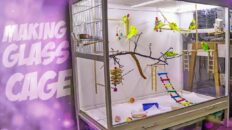
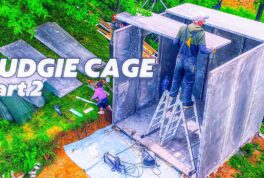
So I built him something different. I call it a walkavarium — a wide, glass-fronted ground habitat where everything is reachable on foot.
This build started almost by accident. I was about to throw out an old tank. It was dirty, scratched, and sitting unused. It started life as my paludarium for vampire crabs, and that project failed. The design had too many flaws and I shut it down.
Instead of dumping it, I converted it for budgies. Specifically for one budgie who needed it.
Here is exactly how I did it, what toys I put inside, what failed, and two other things I was dealing with at the same time in the aviary: suspected French molt in young cockatiels and the start of winter preparation.
Why Pingo Needed a Ground-Level Home
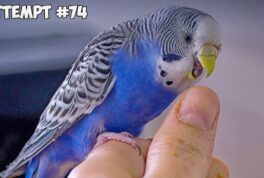
Pingo is a small budgie with a big personality. After feather loss that looks like French molt, he cannot fly at all.
That changes everything about housing:
- High perches are useless if he can’t reach them
- Tall food dishes become obstacles
- Hanging toys he can’t land on are just decoration
- Falls from height are a real risk for a bird with no flight feathers to brake with
What Pingo can do well is walk, climb low ramps and nets, cuddle, and play on the ground. He is also extremely bonded to me. The happiest place for him is still in my hands. The walkavarium is for the hours when I am not there — a safe space where he can explore, forage, and rest without needing to fly.
If you have a budgie with French molt, PBFD, a wing injury, or old age that limits flight, the same principles apply: go wide, not tall. Put food, water, and enrichment at floor level.
From Failed Paludarium to Budgie Walkavarium: The Conversion
1. Deep clean and silicone removal
The tank was old and dirty from the crab setup. I cleaned it completely and removed all the old silicone.
This step matters. Budgies chew everything. Old, loose silicone that a crab would ignore can become a chewing target for a budgie. If he bites off pieces and swallows them, it can block the crop or cause irritation. I scraped it all out rather than covering it up.
If you repurpose any aquarium or paludarium, do the same. No leftover sealant edges, no soft spots he can peel.
2. Background
I found leftover wallpaper from my budgie aviary and used it as the background inside the tank.
It does two things. It makes the space look less like a glass box and more like part of the aviary, and it gives Pingo a visual barrier on one side so he does not feel exposed from all directions. Budgies that cannot fly get stressed in full 360° glass. One solid-patterned wall helps.
3. Front security — still in progress
As shown in the video, I ordered cage fencing for the front. A glass tank with an open top is not safe for a budgie long-term. He can climb out, a cat or another bird can get in, and airflow is poor.
The plan: a proper mesh front that locks airflow in and keeps him in. Until that arrives, this is not his full-time unsupervised home. Do not copy the open version as a finished cage.
Ventilation plus security is the rule for any DIY budgie cage idea. Glass holds humidity and ammonia from droppings. You need mesh for air exchange.
Setting Up the Inside for a Bird That Walks
I placed everything with one rule: if Pingo can’t reach it on foot, it doesn’t belong in there.
The little house, not a nest box
I added a small wooden house with a perch and wide openings. I want to be clear: this is a shelter / chill spot, not a nest box.
Why the distinction matters: a dark, enclosed nest cavity triggers hormonal nesting behavior in budgies. This house has wide entrances, good light inside, and airflow. It is a hiding and resting spot where he can sit and watch the room.
It also has a mesh grid under the sitting area that lets droppings fall through. That keeps his feet cleaner and makes daily cleaning faster. For a ground-dwelling bird that spends all day on the same surfaces, foot hygiene is critical to prevent bumblefoot.
I fixed the house to the back wall with silicone so it does not shift while he climbs on it. Use bird-safe, fully cured silicone and let it off-gas completely before the bird moves in.
Rope climbing net with safe spacing
I added a rope net with wide gaps. Pingo can climb through it without squeezing.
Small, tight loops are dangerous. Toes, legs, and necks get caught. I specifically chose a net where he can pass through comfortably, not one where he has to force his way.
Foraging roller
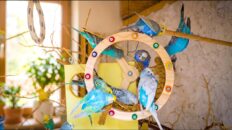
One of the more interesting toys is a small rolling forager. You put seeds inside and the bird has to roll it to get them out.
In practice, this one failed for budgies in my test. The openings are sized for larger seeds, like cockatiel mix. Small millet and canary seed either don’t fall out right or clog. It might work with bigger seeds, or there may be a smaller version made for small parakeets. I am keeping it aside for now rather than leaving a frustrating toy in Pingo’s space.
That is normal for DIY setups. Test first, keep what the bird actually uses.
Bell, perches, and low dishes
Pingo loves his little bell, so that went in. No walkavarium for Pingo — I jokingly call it Pingo World — would be complete without it.
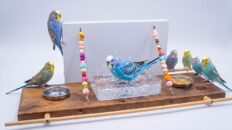
Food and water are at ground level in low dishes. I even 3D-printed a custom food dish for this setup so the rim is low enough for him to eat without climbing.
I also dropped in a small hamster-style accessory as a test hide. It is not a permanent fixture, just something for him to walk through and investigate. Novelty prevents boredom for a bird that lives in a smaller footprint.
Budgie Toy Safety: What I Check Before Anything Goes In
Toys marketed for birds are not automatically safe.
My checklist after years in the aviary:
- No cotton, loose string, or fraying fabric. I avoid them completely.
- No small loops where a head or leg can get stuck.
- No sharp wire ends, lead clips, or peeling paint.
- No nest-like pouches for a single pet budgie unless you want hormonal problems.
I learned the string lesson the hard way. My budgie Angel almost strangled on hanging strings from a toy. The fibers wrapped around her neck. I happened to see it in time and freed her. It looked like a pretty toy on the shelf, but it was a trap.
Ground birds are at even higher risk because they chew from below and can get tangled while no one is watching. If a toy sheds fibers when you pull it with your fingers, don’t put it with a flightless bird.
The two types I used in this video were:
- Budgie toy wheel for climbing / playing
- Stand toy for perching at low height
Both were placed low so Pingo can walk up to them, not fly to them.
Autumn in the Aviary: Winter Prep Has Started
While building, I am also getting the main aviary and garden ready. Mornings here in Bosnia are already around 5°C. Not cold enough to close the aviary doors yet, but you can feel winter coming.
I do not heat straight through autumn. I let the birds adjust gradually.
My approach:
- Keep them dry and draft-free, but let them feel the slow drop from summer to autumn
- This winter I plan to let the aviary run a little colder than last year, still fully safe and dry
- Push nutrition now: varied seed mix, fresh greens, vegetables, plus vitamins and minerals to support feather condition and immunity
A sudden jump from warm indoor temps to freezing outdoor air is what causes problems. A slow seasonal shift lets budgies grow proper winter feathering and adjust metabolism.
At the same time I am cleaning. The budgies had already dirtied my hanging DIY feeding dish, so that got a full wash. Dirty food stations in damp autumn weather grow mold fast.
Fresh fruit from the garden helps too. My budgies get pears and apples. They will even climb to the aviary fence to reach apples growing nearby. If you have unsprayed fruit trees, this is free enrichment and nutrition. Wash everything, remove apple seeds, and offer in small pieces.
Hand-feeding greens and fruit is also how I tame a whole flock. Offer by hand regularly. They start linking you with good things, come closer on their own, and you build trust without grabbing.
Chickens: First Winter With the Flock
This is my first winter with chickens here, so I am learning as I go.
What I have in place:
Heater on standby for the young ones. Adult healthy chickens handle cold far better than chicks. I have a heater ready for the smaller coop but have not turned it on yet. Here it usually gets seriously cold at night from mid-November.
Deep dry bedding for adults. I am building up dry sawdust / wood shavings. Instead of stripping the whole coop every time, I add fresh dry material over the top and remove only wet or caked spots. As the deep layer composts underneath, it gives off a little natural warmth.
This only works if it stays dry. Wet bedding + droppings = ammonia and moisture in the air, which damages lungs and combs. Rules I follow:
- Remove any wet, compacted patches immediately
- Keep ventilation open high up — moisture has to escape
- No direct draft on the birds at roost level
- Dry feet, dry bedding, wind-proof but breathable coop
Chickens handle dry cold much better than damp cold.
Chicks stay in. My tiny chicks are nowhere near ready to go outside. First outing will likely be late winter or early spring depending on weather. That also means I am already planning the next incubation season for late winter. I extended the coop, so I have space for more birds.
I think I have two baby roosters in this batch. Their combs are getting larger and redder earlier than the others, and they are acting bolder and more territorial. Still too young to be 100% sure, but comb development plus confidence is a solid early clue.
And yes, I added solar LED lights to the coop. They do nothing practical. They just make it look nice at night. Sometimes that is reason enough.
If you keep chickens through Balkan winters and have a system that works, leave a comment on the video. I am collecting tips.
Serious Aviary Update: Feather Loss in Young Cockatiels — Suspected French Molt
This is the hard part of the video.
Several young cockatiels started losing feathers right when they should have been taking their first real flights. The growing primary wing feathers and long tail feathers would start to come in, then fall out, deform, or break.
After talking with experienced breeder friends and reading your comments, the pattern points to French molt — the term breeders use for feather dystrophy in young birds linked to avian polyomavirus infection.
I want to be precise here: I have not had a lab confirm polyomavirus in every bird. This is a suspected case based on symptoms and experience. If you see this in your birds, get an avian vet diagnosis. Do not self-diagnose from YouTube alone.
What happens in the feather
Avian polyomavirus attacks rapidly dividing cells. In a fledgling, feather follicles are some of the fastest-growing tissue in the body.
The virus damages the follicle during active growth. Blood supply to the growing feather is cut off or disrupted. The result:
- Hemorrhage around the follicle
- Pin feathers that bleed if bumped — I showed one bird with blood on a developing feather after jumping
- Feathers that grow in twisted, weak, constricted, or break off
- Sudden loss of primaries and tail feathers just when the bird needs them to fly
The bird can look otherwise alert and hungry, but cannot fly. They become runners — ground-dwelling fledglings. That is why the walkavarium concept matters beyond Pingo. A safe ground setup is often the only humane housing for these birds during recovery, if they recover flight at all. Some do with the next molt, some stay flightless.
Why separation was necessary
Avian polyomavirus sheds heavily in:
- feather dust and dander
- crop secretions
- droppings
It contaminates the environment and is very hard to remove. There is no cure that kills the virus once a bird is infected.
The only way to lower risk to the main flock is to separate symptomatic young birds immediately. I moved the affected cockatiels out with a heavy heart. Keeping them in the main aviary because you feel sorry for them puts every other fledgling at risk.
Supportive care is all we can offer right now:
- Good nutrition, not just seed — greens, balanced mix
- Vitamins and minerals as needed, on vet advice
- Warmth, rest, clean air
- As little handling stress as possible
- Stop breeding from affected pairs for the season, disinfect perches, nest boxes, and food stations
If you have dealt with French molt / polyomavirus in cockatiels or budgies, especially in an outdoor aviary, please share what worked for you under the video. Every saved life matters, and breeders learn from each other on this one.
Note: Pingo’s feather loss may have a similar background. That does not automatically mean he is currently sick or shedding virus, but it is why he lives separately and why hygiene between his setup and the main flock is strict. Wash hands, change clothes, clean tools between groups.
What Comes Next for Pingo
The walkavarium as filmed is 90% done. Toys, house, bell, custom dish are in. The front mesh is still on the way.
In the next video I will put Pingo in and see what he actually does. Will he explore and claim it as Pingo World, or will he hate it and want back in a standard budgie cage with me?
Birds vote with their feet. I will follow his lead.
If you want to see that test, subscribe and comment: would you take your budgie for a walk in a walkavarium?
Quick FAQ
What is a walkavarium? My term for a wide, low, walk-in style tank converted into a ground habitat for birds that cannot fly. Everything — food, water, toys, shelter — is reachable on foot.
Can a budgie live a good life without flying? Yes, if you adapt the housing. Wide floor space, low perches and ramps, ground-level food/water, safe chewable enrichment, daily out-of-cage cuddle and exercise time, and clean, dry footing. Pingo is proof — tiny body, huge spirit.
Is French molt contagious? French molt itself is a description of feather damage. When it is linked to avian polyomavirus, that virus is highly contagious between young birds via feather dust, droppings, and crop secretions. Separate symptomatic birds and talk to an avian vet.
How cold can budgies handle in an outdoor aviary? Healthy, acclimated budgies handle cool autumn nights well if they are dry and out of wind. My aviary was seeing ~5°C mornings at filming time with doors still open. The key is gradual acclimation, good nutrition, no drafts, and dry shelter. Avoid sudden temperature swings and damp conditions.
What toys are safe for a flightless budgie? Low stands, flat perches, rope nets with wide gaps, stainless bells, wood chews, and ground foragers sized for small seeds. Avoid cotton huts, stringy toys, mirrors that cause obsession, and anything with small loops or peeling paint.


Add comment