


I did not plan to hand-feed baby budgies that night. I went back to check the nest because something felt wrong, and what I found made me take all the chicks out immediately.
Several babies were heavily plucked. Some had clear bite marks. When I examined one of them closely, I saw the real shock — it had lost most of its upper beak, almost all the way back to the cere.
That is a serious injury for any bird. For a chick only a few days old, it can decide whether it eats or not. I had no idea at that moment if this little bird would survive, how fast the wounds would heal, or if that beak would ever grow back properly.
This is the full story of the rescue, the temporary nursery I built, my first hand-feeding attempts, and what changed in just five days.
Watch the Full Rescue on Video
If you want to see the chicks, the bite marks, the feeding response, and the beak injury with your own eyes, watch the full 20-minute video here:
[Insert YouTube embed for JZBmV4IW70o here]
Why I Went Back to the Nest That Night
Earlier that day I had already found plucked chicks in the nest. I could have left them and checked again in the morning, but with chicks that young, waiting is a risk I do not like to take.
A small change in a baby bird can mean a big problem by morning. They were already settling down for the night when I arrived. They were not scared — there is a small night lamp inside the aviary, so they have enough light to see around them.
The mother was feeding them. From a distance, everything looked normal. No visible sign of illness. No lethargy you could spot from the outside.
Then I looked closer. Injuries. Clear bite marks. That was enough for me. I decided right there to take these babies out of the nest right now, not in the morning.
They were still so young. If something was biting them in the nest, another night inside would only make it worse.
What Could Have Caused the Biting and Plucking?
I had a few theories at first, and I looked for signs of each one before I made any decision about ending the breeding season.
Another female getting in the nest was the first possibility I thought of. It happens in a shared aviary. A hormonal female looking for a nest can attack another female’s chicks. I had not actually seen it happen, so I could not prove it.
The mother herself was the second possibility. Sometimes a female starts biting or plucking her older chicks when her hormones push her to prepare the nest for another clutch. The older babies become competition for the next round of eggs.
Stress can also turn a normal mother into an aggressive one. Frequent disturbance around the nest, too much traffic in the aviary, noise, or predators nearby can all play a role.
Nutrition cannot be ignored either. A lack of calcium, protein, or other essential minerals can affect a breeding female and her chicks. A hen that is depleted is a hen more likely to behave badly.
After looking more closely, my conclusion was that it was not just one intruder. The other females were involved, and obviously the mother too. This was not a simple case of one bird slipping into the wrong nest box. It was a colony problem, and that changes how I handle the rest of the season.
I Officially Ended the Breeding Season
That night I made the call: the breeding season for my budgies is officially over for this year.
It is not always easy to end it, but November and the lower temperatures help. Cold weather naturally discourages breeding activity, and I am not going to fight that.
Once these two youngest babies are ready to leave the nest, I will close it permanently as soon as possible. No more breeding attempts. No more fights around the nest.
Of course, there will always be that one female who decides a wall needs a new hole, or who starts digging around the feeding stations and exploring every possible place to lay eggs. That is just part of keeping budgies in captivity. Their natural instincts do not disappear just because we give them everything they need.
These babies are literally saved. They will spend the entire winter with me. When spring arrives, they should be strong enough to return to the garden aviary and finally become a proper part of the flock.
The Temporary Nursery: A Repurposed Terrarium
I already knew what I would use. I had a terrarium prepared for my future vampire crabs, but it found a completely different purpose that night.
Ideally darker walls would make a more comfortable, less stressful environment for the babies. In this case, the light, visible setup had an advantage: I wanted them to get used to seeing people around them from the start. Chicks that grow up calm around humans are easier to feed and easier to tame later.
As always, I used Katpio organic litter as bedding. I have used it for a long time because it absorbs moisture well and helps keep the floor dry by taking in the droppings. With hand-fed chicks, dry bedding is not a detail — wet bedding chills babies fast.
One thing I always recommend for a temporary home for baby birds: use a square or rectangular setup, not a round one. The same goes for bird cages. Straight walls make it much easier to arrange perches, food and water, and give the birds more usable space. A round enclosure wastes corners and makes everything harder to organize.
The Next Morning: Worse Than I Thought
Even after my quick examination the night before, I did not fully realize how serious their condition was. I could only see the full picture the next morning in better light.
They were all tucked up together trying to keep warm, barely moving around. That was a worrying sight. Healthy chicks that age should be active, calling, and moving toward food.
This was the moment I understood: these babies had not been getting enough food in the nest. I was not just rescuing them from biting. I was rescuing them from hunger.
My First Attempt at Hand-Feeding Baby Budgies
This was my very first attempt at hand-feeding these little ones, and I did not know exactly how much food they had been getting from their mother or how often she had been feeding them.
I mix the hand-feeding baby bird formula with warm water until I get the right consistency. It should look like pancake batter — not too watery and not too thick. Too thin and you are basically feeding water. Too thick and the chick has to work too hard for every mouthful.
Temperature is just as important as consistency. The formula needs to be warm, around 38°C or 100°F, but never too hot and never too cold. Too hot can burn the crop. Too cold and the chick will refuse it — and cold formula sits badly in a tiny stomach.
I prepare it fresh every time, and I work quickly. The food cools down surprisingly fast, especially in small amounts like this. By the time you have fed the first chick, the last spoonful is already colder than you want.
That feeling that they might starve if they do not eat enough never really goes away. Even after years of experience, I still worry every time I have to hand-feed baby budgies. They can be hungry and still be afraid. They do not know what to do with the spoon yet.
So at first, even a tiny amount is a good start. Think of it as their first training session. Do not panic if they do not eat much during the first attempt. They need time to get familiar with the process.
But after some time, usually within the first 24 hours, something changes. They suddenly understand what is happening and start eating with incredible enthusiasm, almost as if they are fighting for their lives. That switch from fear to appetite is the moment you know the rescue is working.
Spoon vs. Syringe — Why I Use a Spoon
Personally, I find using a spoon much easier than a syringe. It is faster for me, it gives me better control, and the formula does not cool down quite as quickly during feeding.
There is a much more serious reason to be careful here, though.
Inside a baby budgie’s throat there are two very important passages very close to each other — the esophagus, which carries food down to the crop and stomach, and the trachea, which carries air to the lungs. If formula accidentally enters the airways, it can cause aspiration and serious complications.
That is why hand-feeding requires patience, the right technique, and plenty of care. The food should never be forced into the chick’s mouth. Incorrect feeding can cause aspiration, where food enters the airways instead of the digestive system. That can kill a chick faster than hunger.
As soon as the warm formula touches the baby’s beak, you sometimes see an incredible feeding response. They start moving their heads up and down in a fast, rhythmic motion, almost like a miniature jackhammer. It is quite a sight, especially when you see it for the first time.
The Crop: A Tiny Fuel Gauge
Another interesting feature you can actually watch during feeding is the crop. It is a small food storage pouch located at the base of the neck, where food stays temporarily before moving further into the digestive system.
During feeding, you can see it gradually filling with formula, almost like a little fuel gauge. That is useful — you can see with your eyes whether the chick is actually swallowing. But it is also something you need to monitor carefully. The crop should never be overfilled.
During my first feeding session, what I noticed was quite worrying. Some of the babies were extremely hungry and their crops were completely empty. That told me they probably were not getting enough food in the nest, and they were in a much worse condition than I initially realized.
They were really struggling in there. I can only imagine how things might have turned out if I had waited until the next morning to take them out. This was truly their lucky day — and hopefully the beginning of a much better journey for these little ones.
A Trick That Works With Chicks and With Taming
Here is another little trick. If one of the babies is more confident and starts eating, the others can learn by watching. Seeing another chick accepting the food can help them realize it is safe, and they may soon follow along.
It is basically the same principle we use when taming budgies. They learn a lot by copying each other’s behavior. One brave chick can save you a lot of time with the shy ones.
The Beak Injury: What Happened to This Chick?
Bite marks can heal quite quickly. But this was not a normal bite mark.
I had never experienced or even seen this kind of injury before. Even after all these years of keeping budgies, this baby had suffered a severe injury, losing its upper beak almost all the way back to the cere, along with some feather plucking on the back of its head.
Because the damage is so deep, the chances of the upper beak growing back completely are very slim. If the underlying bone and growth zone are damaged, it will not regenerate. And even if only the keratin layer was lost, any regrowth will likely be slow and deformed.
I named this little one Nubs — it fits him perfectly.
Can a Budgie Survive Without an Upper Beak?
This is the question everyone asks, and the honest answer is: yes, it is possible, but it will not be easy.
Budgies can adapt remarkably well. Even without an upper beak, they can still enjoy a long and happy life. A budgie’s beak is much more than just a tool for cracking seeds. It is made of a continuously growing keratin layer covering a bony structure, and it is full of sensitive nerve endings that help the bird feel and explore its surroundings. The beak also works together with the tongue when eating, climbing, and handling different objects.
When a budgie loses its upper beak, the muscular tongue can help it collect and move soft food inside the mouth, while its feet and wings take over much of the work when climbing. It is a completely different way of living, but it shows just how adaptable these little birds can be.
For a bird like Nubs, I will use a specialized diet of soft foods and hold seeds served in deeper dishes, so he can scoop food up without needing to crack it. As the lower beak does not have an upper beak to wear against, it may need trimming to prevent overgrowth. And any sign of infection needs immediate attention.
It is not going to be an easy journey. But this little bird still has a chance at a happy and comfortable life, and I will do my best to give him that chance.
Five Tiny Dinosaurs
And here they are — my five tiny dinosaurs on their very first day of hand-feeding.
It is going to be amazing to watch their transformation as they grow, especially because they have such a unique color mutation. It is almost like someone mixed every possible budgie color into one little bird. I am really curious to see how their feathers will develop over the coming weeks.
Their names are still being decided, and I asked my viewers what they think. Predictably, Nubs was already taken.
The Storm, the Cat, and a New Night Routine
At 1:00 in the morning I suddenly heard the budgies making noise. There was a loud thunderstorm outside with heavy rain, so they must have been frightened by the thunder. I had to come and check on them.
And then I saw the real problem. The cat had taken his chance and climbed onto the aviary trying to catch the budgies. Luckily, no one was hurt.
But from now on, it is time to close the aviary doors overnight. The cats are becoming very aggressive, even towards my chickens. I have seen them chasing the chickens around the garden, and that is something I definitely do not want to risk with five hand-fed chicks.
I woke up to snow this morning. Officially, outdoor activities for the birds are over for this year. Temperatures of minus 3°C are expected overnight, so all the aviary doors will stay closed and all the birds will be tucked safely inside. It is time to switch to winter mode.
Day Two: They Already Know Me
It is day two, and there is complete chaos in here. They are calling me, jumping around, and getting excited as soon as they see me.
They already understand that I am their food source. Almost as if I have been here since the very beginning. It is amazing how quickly they can adapt. But at the same time, it tells me something quite worrying.
Their reaction makes me think they were much hungrier in the nest than I initially realized. These little guys clearly were not getting enough food, and I am just glad I managed to get them out in time. Now the real journey begins.
Keeping Chicks Clean After Feeding
Another small but very important detail is keeping the babies clean after feeding. Hand-feeding formula can dry into a hard crust surprisingly quickly.
At this age, around 7 to 12 days old, the chicks are becoming much more active and messy during meals. Food can easily end up on their faces, around their nostrils, and even on their chests.
That is why I always pay attention to any leftover formula. Once it dries, it can be difficult to remove and may cause problems, especially around their nostrils or developing pin feathers. A little warm, damp cloth can help clean these areas gently before the formula has time to dry.
Do not skip this step. Formula crust around the nostrils is not just ugly — it can interfere with breathing and skin health in a chick that is already tiny and fragile.
Why Nutrition Matters So Much at This Age
Feathers are made mainly of keratin, a strong structural protein. When you think about how many new feathers these little chicks have to produce at the same time, you can imagine how much energy and nutrition their growing bodies need.
This is also why proper nutrition is so important at this stage. Their hand-feeding formula must provide the right balance of protein, energy, vitamins, and minerals to support healthy development. If the formula is prepared incorrectly or does not provide enough nutrients, their growth and feather development can suffer.
It is quite amazing when you think about it. In just a few weeks, these tiny, almost naked babies will transform into fully feathered little budgies. And all that development depends on getting the right nutrition from the very beginning.
After 5 Days: The Bite Marks Are Gone
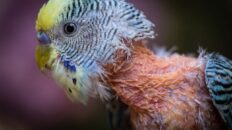
And look how much they have changed in just five days. The bite marks are gone. Their injured wings have healed and their feathers are already growing incredibly well. It is amazing to see such a difference in such a short time.
The only thing left to do is gently clean the dried food from their feathers using warm water. But they are still not very active, so I do not want to disturb them too much. Rest is important, and I will give them the time they need.
Just look at them now. A beautiful little flock of tiny dinosaur birds. It is hard to believe how different they looked just five days ago.
Frequently Asked Questions About Hand-Feeding Injured Budgie Chicks
Can a budgie survive without an upper beak? Yes, budgies can adapt and live a long life without an upper beak if they are given soft foods, deep dishes, regular lower beak checks, and protection from infection. It takes more care than a normal bird, but it is possible.
Will a budgie’s beak grow back after this kind of injury? If only the outer keratin layer is lost, some slow regrowth may happen, but it is often deformed. If the bone and growth zone near the cere are damaged, full regrowth is very unlikely.
What temperature should budgie hand-feeding formula be? Around 38°C or 100°F. Never serve it hot, and do not let it cool down too much during feeding. Check the temperature before every spoonful.
Spoon or syringe for hand-feeding budgies? I prefer a spoon because it gives me better control and the formula stays warm longer. Whichever tool you use, never force food into the chick’s mouth because of the risk of aspiration.
Why do mother budgies pluck or bite their chicks? Common causes include another female attacking the nest, hormones pushing the mother to prepare for the next clutch, stress from disturbance, and nutritional deficiencies such as low calcium or protein.
How fast did these chicks recover? Bite marks and wing injuries healed visibly within five days once the chicks were removed from the nest, kept warm and dry, and fed on a regular hand-feeding schedule.




Add comment