



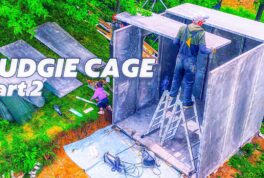
This week I did two jobs in the garden before winter closed in. I finished a small 2 by 2 meter aviary from the ground up, and I fitted huge 6-meter polycarbonate panels on my large flight to block cold wind and rain.
My birds got through last winter because they had dry shelter, no drafts, and time to acclimatize. This year I wanted the same, only better. Here is exactly what I built, what materials I trust after two years outside, and how I run the night routine after the first frost.
I am Alen from Bosnia, and I keep a large mixed flock of budgies and zebra finches in outdoor aviaries. Cookie, my mascot budgie, is the reason this channel exists. Everything below is what I actually do, not theory.
Why I Built One More Small Aviary Before Winter
I had maybe two or three sunny days left. The spot I picked is small, almost 2 by 2 meters, tucked in the garden. Over the years I tried different ideas there and changed plans more than once.
I wanted one solid, permanent structure that I can use now and decide on properly in spring. Right now chickens are using it for a day or two to catch the last sun before they move back to the chicken coop for winter. In spring this can become a proper flying aviary for small birds.
If you plan to build in spring, use this as a checklist. Planning dimensions before you cut saves hours.
Base First: Predators Decide the Design
Looks do not matter if the birds inside are not protected. In my area we have martens, neighborhood cats, and my own cat Tom. Tom is a hunter by instinct.
Here is how I secured the base:
- Concrete blocks around the full perimeter. This stops digging from underneath.
- Raised solid walls on the lower section. This keeps cats from reaching through and pawing at birds that sit low.
- Wire barrier planned to go under and around the structure so nothing can tunnel in.
Even with blocks in place, I do not skip the buried wire. A marten only needs one weak spot.
Poles, Spacing and Fencing: What Actually Holds Up
I set all poles perfectly vertical and firmly fixed. I keep the distance between poles to no more than 1 meter.
There are two practical reasons:
- 1 meter spacing makes the whole frame much more stable in wind.
- Fencing usually comes in 1 meter wide rolls, so you cut less and waste less.
On my larger aviaries I installed the fencing vertically. On this small one I did it differently. Because the width of the roll matched the height I needed, I wrapped the fencing around horizontally. Fewer cuts, fewer joints, and fewer joints means fewer weak points that can loosen over time.
For fencing I only use PVC coated mesh. A friend built with uncoated mesh and after a few months it started to deteriorate and he had to redo the whole job. The PVC coated mesh on my budgie aviary has now held up well for 2 years through sun, rain and snow.
I Built The Door From Scratch – It Was Easier
This was my first time building a door piece by piece directly for the aviary, to fit the opening exactly.
It was easier than trying to fit a pre-made door. I could adjust as I went, check the gap, and get a clean close with no pinching.
Two rules for the door:
- Make it square and test it three times before you paint.
- Leave no gaps a marten paw can pull through.
Paint and Roof: Anthracite and Polycarbonate
Painting is a must, wood or metal. Weather here is merciless. I used an anthracite color. It looks clean and gives the structure a finished look.
Important: use a bird-safe coating and let it cure completely before birds go anywhere near it. Do not rush this because of weather. Paint fumes in a closed aviary are dangerous.
For roofs I always use polycarbonate sheets. They are durable and weather-resistant. Installed at an angle, snow slides off almost like butter. You must screw them down properly. Strong wind puts a lot of pressure on a roof sheet and it will lift if you shortcut the fixings.
Plan sunshade from day one, under or on top of the roof. Summers have become extremely hot. Birds need a shaded corner to escape direct sun and cool down. It is much easier to include shade in the original design than to retrofit it in July.
Winter-Proofing The Big Flight: 6-Meter Polycarbonate Panels
Right after the first frost, the polycarbonate sheets for the huge aviary arrived. Each sheet is 6 meters long. Getting them up the hill alone was the hardest part of the whole job.
A viewer suggested these panels last year and I finally put the idea into practice.
Why panels: with a large flock, I cannot keep all birds in the small enclosed section for the whole winter. It is too tight. Panels raise the temperature inside, stop cold drafts, and keep rain out, so birds can still use the flight during the day.
How I install them:
- I cover the wind-exposed sides, not the whole aviary airtight.
- I leave gaps for air circulation. Good airflow in winter matters as much as warmth. Sealed damp air causes more respiratory problems than cold dry air.
- I check the next morning after wind. No rattling, no open corners.
The difference is immediate. Inside feels cozier, no cold draft moves through, and the next morning the whole place looked better in low light.
These are temporary. I will keep them until around May, when nights are reliably warm enough to open the aviary fully again.
I did not fit these panels on the budgie section. Budgies already have plenty of space in their enclosed part, and from what I observe, budgies handle cold better than my smaller zebra finches. Last year I was cleaning the aviary while it was snowing and the budgies were going about their business like nothing changed.
That does not mean birds are immune to cold. It means shelter, dry bedding, wind protection, and gradual acclimatization do the work.
Budgies vs Zebra Finches in Cold: What I See
Both species live outside with me, but they are not the same.
Budgies are tougher in cold wind if they are acclimatized, dry, and can get out of draft. My flock is going into its second winter outside for many birds.
Zebra finches are much smaller, lose heat faster, and need more careful wind protection. That is why the polycarbonate went on the finch side of the large flight.
Rule I follow every year: do not take a budgie from a warm living room and put it outside in freezing weather. The sudden change can kill. Outdoor wintering only works when birds adapt gradually through autumn, with shelter to retreat to.
Young, sick, or featherless birds do not belong outside near freezing, even if the rest of the flock is fine.
My Night Routine After First Frost
When the first frost hit, I switched to winter mode:
During the day, birds stay out. They look unbothered by cold, even babies waiting for parents to feed them. I was freezing, they were chilling.
Every evening I close the aviary doors and check all birds are safely inside the sheltered section for the night. No exceptions from now on.
Dry bedding, closed doors, no wind inside the sleeping area. That is the whole system.
Health Note From The Pet Shop: Ivermectin
On the Hungary trip I stopped in a pet shop and found Ivermectin available for budgies.
Vets use ivermectin as an anti-parasitic for certain parasites in birds, including scaly face and scaly leg mites and air sac mites. For lice or worms, other treatments are usually needed.
I mention it because many keepers deal with mites and do not recognize them early. Check beak, cere, legs and breathing. If you suspect scaly mites or air sac mites, talk to an avian vet for correct dosing. Do not guess doses from internet photos.
Side Notes From This Video: TerraPlaza and Tropicarium
I drove to Hungary with family for TerraPlaza, one of the biggest terrarium and exotic animal fairs in this part of Europe. I got VIP entrance before opening.
What I saw: spiders, snakes in many colors, turtles, bearded agamas, a chameleon with real personality, huge crabs, complete ant-keeping setups with queens, terrarium plants and equipment. My side quest was purple vampire crabs for my paludarium. I would love to breed them and build a colony because their breeding behavior is interesting.
I resisted a turtle, barely. At one point I was even thinking about keeping one in the small aviary. That is how my brain works.
What helped me decide against a chameleon: habitat. Lighting, humidity, plants, space. At TerraPlaza you can buy everything, but you still have to maintain it daily. Exotic is not just buying, it is providing.
I also brought home a beautiful orchid for my wife.
In Budapest we kept a promise to my daughters Mila and Lala and went back to the Tropicarium in a shopping mall. It feels like a tiny zoo with an open rainforest part. Zebra finch building a nest right in front of me, free-flying birds everywhere, crocodile, owls in a huge aviary-like terrarium, lizards, a tiny monkey that looked like a pygmy marmoset, then aquariums and a huge ocean tunnel with rays over our heads and sharks. Mila loved the ray petting most. I did not film it. Sometimes you put the camera down.
Hungary also has a much larger bird fair, so I am thinking about driving back next spring for birds. Let me know in the comments if I should film that trip.
Watch the full build and winter install here: My Birds survived because of these panels — here’s what I did
Have a budgerigar question? Ask here: Alen AxP Questions
FAQ: Outdoor Budgie Aviary in Winter
Can budgies stay outside in winter? Mine do, but only because they live outside year-round, adapted gradually through autumn, and have a dry, draft-free shelter every night. An indoor budgie moved suddenly to freezing temperatures is at serious risk.
Do I need to fully close the aviary with panels? No. I cover wind sides with polycarbonate and keep ventilation open. Trapped damp air is worse than cold dry air.
What mesh lasts outside? In my experience PVC coated mesh lasts. Mine is at 2 years and solid. Uncoated mesh rusted on a friend’s build within months.
When do you remove winter panels? I plan to keep them until around May, when nights stay warm.
What temperature is dangerous? Around freezing can be dangerous for birds that are not acclimatized, and for young, sick or featherless birds even with shelter. Watch behavior: fluffed up, sleepy, sitting on the floor in daytime means bring them in and get advice fast.



Add comment